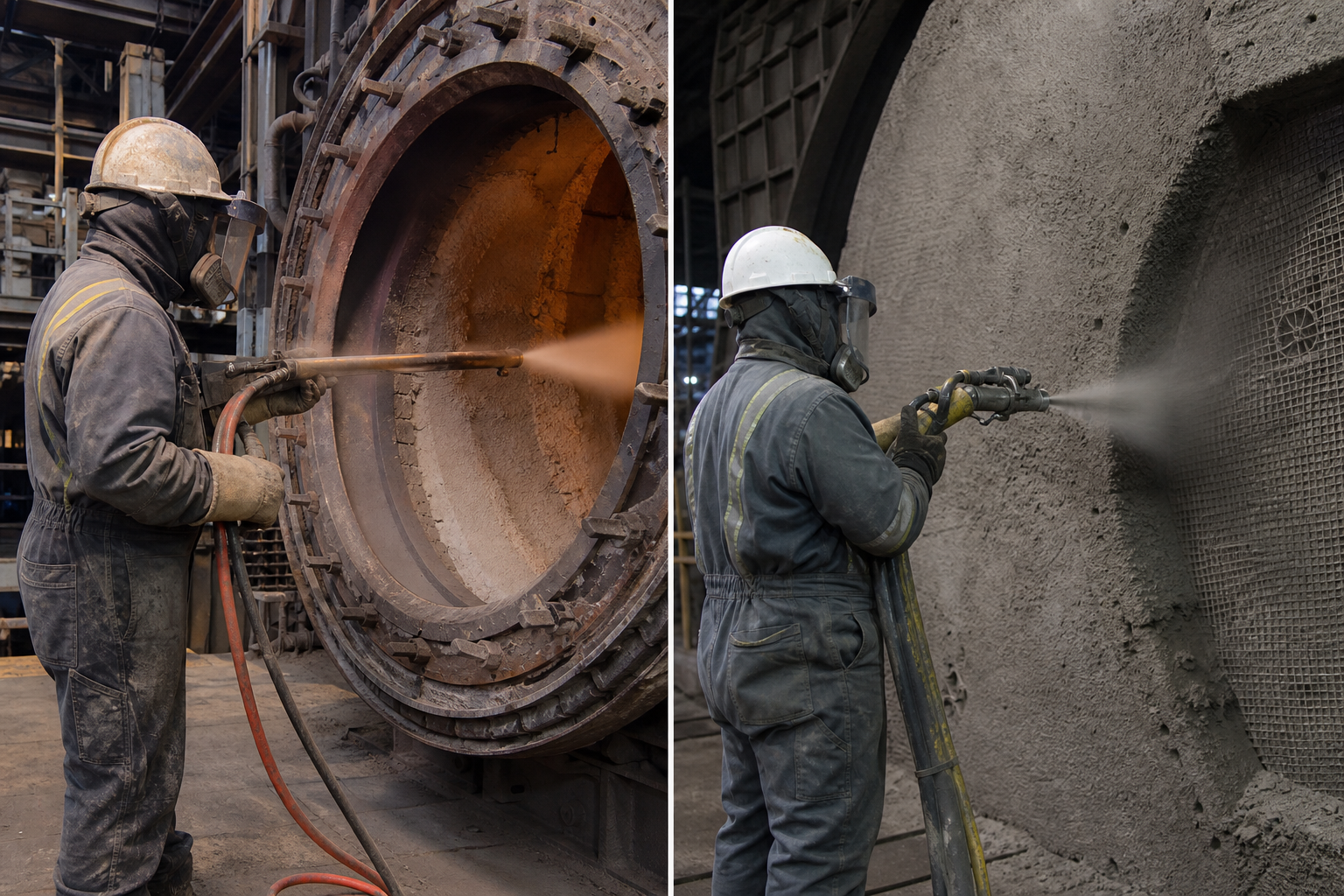
Selecting the correct refractory application method affects lining quality, worker safety, material consumption, shutdown duration, and total project cost. Dry gunning and wet mix shotcreting are both established techniques used across steel, cement, power, oil and gas, aluminium, and sponge iron facilities ??? but they are not interchangeable. Each excels in different scenarios.
Rincecrete Scientific Services provides gunning, shotcreting, robotic application, pumping, casting, ramming, and anchor supply as part of turnkey refractory solutions. This article offers a practical comparison to help plant engineers, maintenance managers, and project planners choose the right method for hot repairs, cold maintenance, and full relines.
Understanding dry gunning
Dry gunning pneumatically conveys refractory material to a nozzle where water is added at the point of application. The operator adjusts water at the nozzle to achieve workable consistency on site. Because the mix is transported dry, gunning equipment can reach irregular shapes, overhead surfaces, and areas where formwork would be impractical ??? making it a preferred choice for emergency hot repairs and targeted patching.
Gunning is versatile and fast to mobilise. Crews can access difficult geometry in kilns, pre-heaters, cyclones, ladles, and furnace walls without extensive setup. For small areas where downtime must be minimised, gunning remains an essential tool in the refractory toolkit.
However, gunning carries well-known trade-offs. Rebound ??? material that fails to adhere and falls away ??? typically ranges from 10???15%. That waste increases material cost and creates cleanup work in active plant areas. Dry gunning also generates significant dust, which affects visibility, respiratory exposure, and housekeeping standards. Installed linings may exhibit higher porosity compared with wet mix shotcreting, which can influence thermal performance and wear resistance depending on material grade and application quality.
Understanding wet mix shotcreting
Wet mix shotcreting uses material that is pre-damped or mixed before delivery to the nozzle. Rincecrete applies wet mix with Putzmeister TK20 equipment at output rates of approximately 6???7 tonnes per hour. Because water is incorporated before application, the process produces more consistent moisture distribution, higher placement rates for large areas, and substantially lower rebound ??? typically only 4???5%.
The result is a denser, lower-porosity lining with improved compaction when executed by skilled crews. Dust generation is far lower than dry gunning, contributing to a healthier work environment and easier inspection during application. Wet mix shotcreting is well suited to full relines, large surface areas, and projects where material efficiency and lining performance justify mobilisation of pumping equipment.
Shotcreting requires hose routing, pump setup, and coordination between pump operators and nozzle crews. Access must accommodate delivery lines. For very small patches, mobilisation cost may favour gunning ??? but for substantial scope, wet mix economics often improve dramatically.
Comparing rebound and material efficiency
Rebound directly increases material purchase quantity and waste handling. On a job requiring hundreds of tonnes of refractory, the difference between 15% rebound and 5% rebound is not trivial ??? it can represent tens of tonnes of material and meaningful cost, plus associated logistics inside a plant during shutdown.
Lower rebound also means less time spent clearing fallen material from grates, floors, and equipment ??? time that does not advance the shutdown schedule. For plants tracking total shutdown cost, material efficiency should be modelled explicitly when comparing bids that specify different application methods.
Rincecrete advises clients on realistic rebound expectations for each method and material type, and plans logistics accordingly. Transparency in estimating builds trust and prevents surprises during execution.
Dust, safety, and working conditions
Occupational health considerations are increasingly central to contractor selection. Dry gunning in enclosed kiln sections, pre-heaters, or furnace enclosures can elevate respirable dust levels without aggressive ventilation. Wet mix shotcreting materially reduces airborne particulate generation, improving conditions for applicators and adjacent trades.
Safety planning must still address hose pressurisation, pump maintenance, and communication between crews. Neither method is inherently safe without training. Rincecrete's Academy-trained crews and zero-accident culture apply regardless of technique ??? but method selection influences baseline exposure profiles that safety officers evaluate.
Installation rate and shutdown windows
Shutdown schedules drive method choice. Gunning can begin quickly for localised repairs when equipment is already on site. Wet mix shotcreting places volume faster across large areas once pumping systems are commissioned ??? often shortening the refractory phase for full relines.
Robotic shotcreting extends these advantages in high-risk furnace work by sustaining application with reduced personnel rotation inside vessels. The optimal approach may combine methods: gunning for urgent stabilisation, shotcreting for bulk lining placement, robotics where access and safety demand it.
Porosity, density, and lining life
Engineering teams specify refractory grades based on thermal, chemical, and mechanical requirements ??? but installation quality determines whether the material performs as designed. Higher porosity from inconsistent gunning application can increase heat loss, penetration risk, and erosion susceptibility. Wet mix shotcreting, applied correctly, tends to produce denser linings with better compaction ??? particularly valuable in aggressive zones such as kiln inlets, transition areas, and furnace hearths.
Method selection should always be validated against material supplier recommendations and historical performance at similar plants. Rincecrete coordinates with client engineering and refractory suppliers to align application technique with specification.
Decision framework for plant managers
Choose dry gunning when you need rapid hot or cold repair of limited area, irregular geometry, or emergency stabilisation where setup time must be minimal. Choose wet mix shotcreting when scope involves large surface area, full relines, strict material efficiency targets, or improved density and dust control. Consider robotic shotcreting when access is hazardous, profiles are complex, and thickness repeatability is critical.
Evaluate total cost ??? not only rate per tonne installed ??? including rebound, cleanup, exposure hours, lining life, and schedule risk. The cheapest mobilisation is not always the lowest total cost.
Work with application specialists
Rincecrete Scientific Services, established in Hyderabad in December 2023, supports steel plants, cement plants, oil and gas facilities, power plants, aluminium plants, and sponge iron units across India. We provide honest method recommendations and execute with Putzmeister equipment, robotic systems, and trained crews. Contact us for a scope review ??? we will help you select the right refractory application method for your next shutdown or emergency repair.