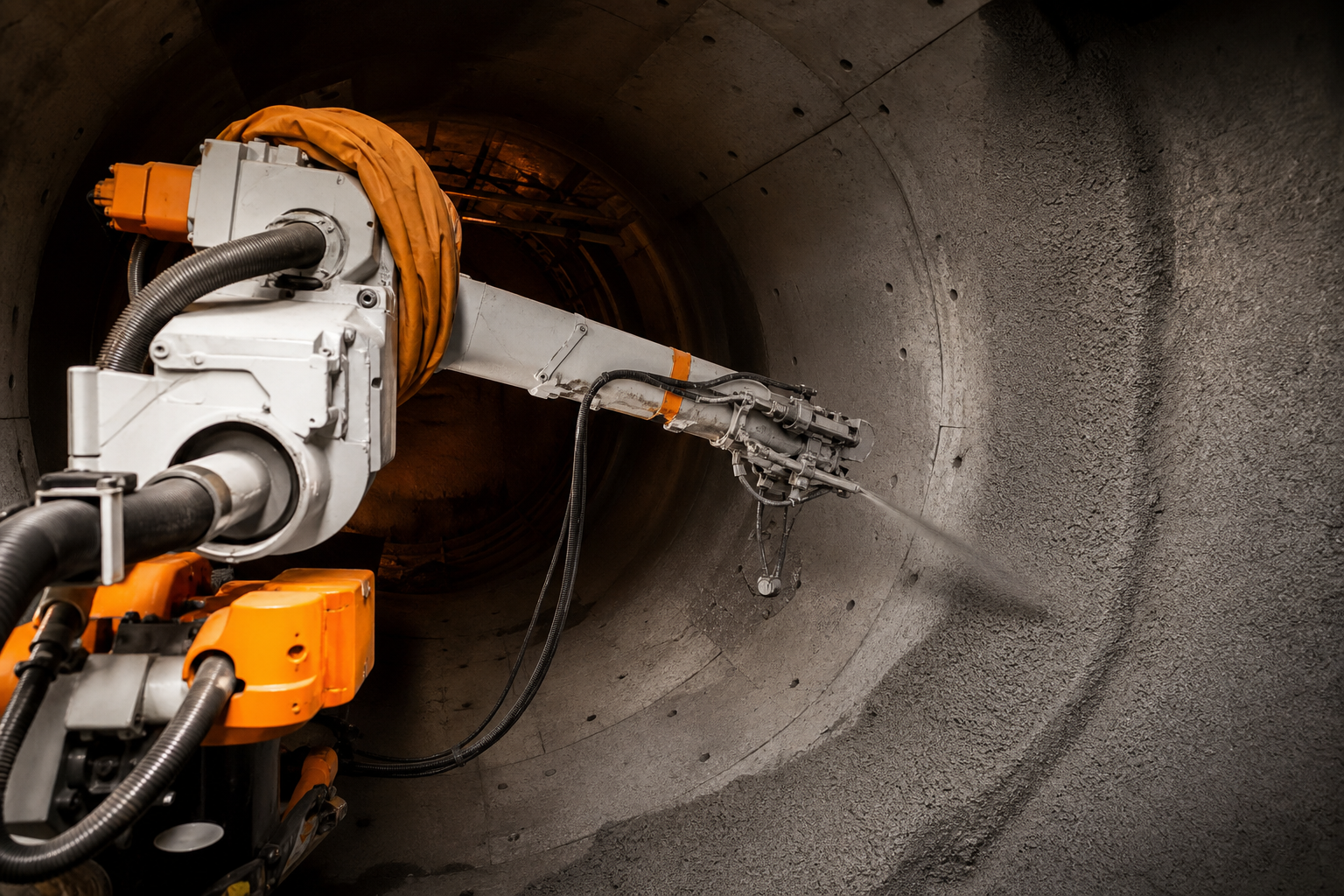
Blast furnace and Corex relines are among the most capital-intensive maintenance events in integrated steelmaking. Shutdown windows are measured in hours and days, not weeks. Lining quality directly affects campaign life, energy efficiency, and production stability. At the same time, the interior of a furnace during reline is one of the most hazardous workplaces in industry ??? hot surfaces, confined geometry, falling material risk, and limited escape routes.
Robotic shotcreting is changing how leading operators approach these projects. By combining wet mix shotcreting technology with remote-operated robotic pods, Rincecrete Scientific Services delivers precision refractory placement while keeping personnel outside the highest-risk zones. This article explains why robotic shotcreting is gaining adoption, how it works in practice, and what plant managers should consider when evaluating it for their next reline.
The limits of manual application in furnace relines
Traditional manual shotcreting requires skilled nozzle operators to work inside the furnace shell, often on scaffolding or mobile platforms, directing wet mix material onto targeted areas. Human performance varies with fatigue, visibility, heat exposure, and access angle. In large furnaces, reaching consistent thickness across complex curvature is demanding even for experienced crews.
Safety is the greater concern. Personnel inside a furnace during reline may be exposed to residual heat, sharp refractory remnants, overhead work risks, and communication delays in noisy environments. Every hour spent inside increases exposure. Shutdown schedules amplify pressure to hurry ??? a combination that makes robust safety systems and highly skilled crews essential.
Robotic shotcreting does not eliminate the need for expertise. It relocates the operator to a control position, applies material with programmed mechanical consistency, and reduces the total time humans must spend in confined, high-risk areas.
How robotic shotcreting works
Rincecrete deploys robotic pods integrated with wet mix shotcreting systems, including Putzmeister TK20 equipment capable of placing material at 6???7 tonnes per hour with rebound as low as 4???5%. The wet mix is pre-damped, pumped through the delivery line, and applied through a robotic arm that can be positioned and programmed for the target profile.
Heat-resistant chain hoists such as GIS GP1000 units support positioning in high-temperature environments. Operators monitor application from a safer vantage point, adjusting parameters to maintain thickness, density, and surface finish. Mechanical paths reduce the variability inherent in manual nozzle movement ??? particularly important for zones where uniform compaction is critical to lining life.
Robotic gunning and robotic shotcreting are complementary capabilities. The correct method depends on material specification, access geometry, temperature conditions, and repair scope. Our technical team selects equipment and application strategy during planning ??? not as a one-size-fits-all default.
Precision, thickness control, and lining performance
Refractory lining performance depends on correct material selection and correct installation. Porosity, joint density, and thickness uniformity influence thermal efficiency and resistance to erosion, chemical attack, and mechanical wear. Inconsistent application can create weak points that fail early in campaign ??? a costly outcome for any steel plant.
Robotic shotcreting improves repeatability. Programmed paths help ensure that each pass overlaps correctly and that target thickness is achieved across curved and vertical sections. Combined with wet mix technology's superior density compared to dry gunning, the result is a lining installed with fewer voids and lower rebound waste.
For blast furnace hearths, bosh areas, tuyere surrounds, and Corex vessels where profile complexity is high, that repeatability translates into measurable quality assurance ??? and easier documentation for engineering review.
Safety outcomes that matter during shutdowns
Plant safety departments increasingly evaluate refractory contractors on exposure hours inside vessels, not only on incident rates. Robotic application can materially reduce those hours. Workers remain outside the immediate fall zone and heat envelope for a larger proportion of the job.
This does not remove all risk. Rigging, hose management, pump operation, and entry for inspection still require strict protocols. Rincecrete integrates robotic deployment within our broader zero-accident framework ??? Academy training, health screening, permit coordination, and site supervision remain mandatory on every project.
The safety case for robotics is strongest where manual access is most dangerous: high-heat relines, confined cylindrical geometry, and extended duration applications where fatigue would otherwise accumulate.
Schedule compression and total project cost
Shutdown delays can cost steel plants enormous sums in lost production. Installation rate matters. Wet mix shotcreting at 6???7 tonnes per hour places large volumes quickly. Robotics sustains application with fewer interruptions from crew rotation inside the vessel and with consistent pace across shifts when conditions allow continuous operation.
Material efficiency also affects cost. Rebound of 4???5% means less waste and less cleanup compared with dry gunning at 10???15% rebound. Lower dust reduces ancillary ventilation and housekeeping burden. Faster, cleaner application can shorten the refractory phase of a shutdown ??? freeing time for inspection, drying, heat-up, and commissioning.
Total cost of ownership should include lining life, not only installation price. A denser, more uniform lining installed robotically may extend campaign duration and reduce emergency hot repair frequency ??? benefits that accrue long after the shutdown team has left site.
When to specify robotic shotcreting
Robotic shotcreting is recommended for blast furnace relines, Corex vessels, large rotary kilns, and other applications where confined space, heat, or profile complexity make manual application hazardous or inconsistent. It is particularly valuable when shutdown windows are tight and engineering teams require documented thickness control.
It may be less economical for small hot patches accessible in minutes, or where material specification favours dry gunning for rapid stabilisation. Rincecrete provides honest method selection ??? gunning, shotcreting, pumping, casting, ramming, and robotic solutions ??? based on scope, not equipment availability alone.
Discuss robotic shotcreting for your next reline
Rincecrete Scientific Services is based in Hyderabad and serves refractory-intensive industries across India. Our teams combine robotic technology, Putzmeister wet mix equipment, and experienced supervision to deliver safer, faster relines. Contact us to review your furnace geometry, lining specification, shutdown schedule, and safety requirements. We will prepare a value-engineered application plan aligned with your production priorities.