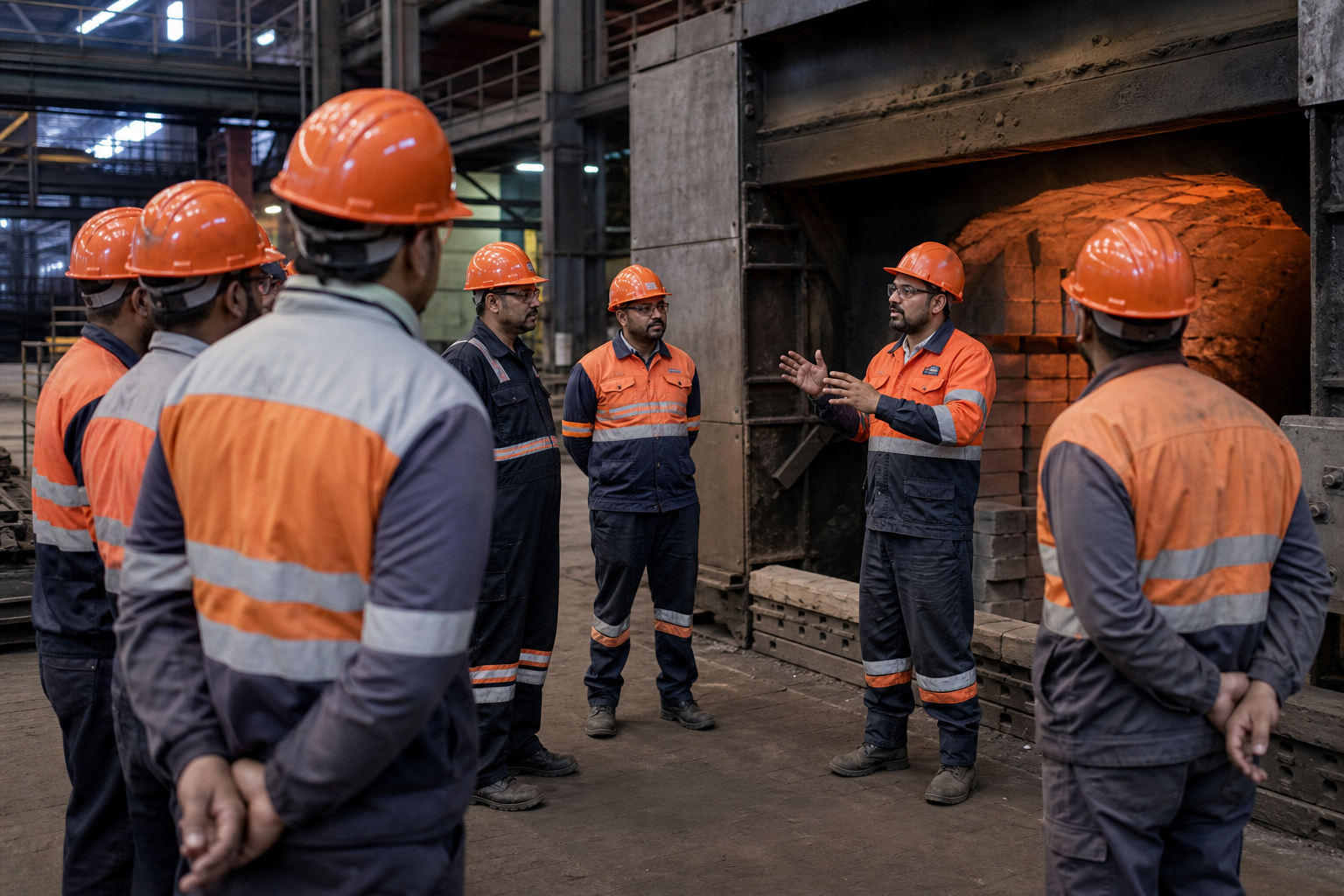
Refractory application work takes place in some of the most demanding environments in heavy industry: inside blast furnaces, cement kilns, rotary vessels, and confined high-temperature zones where a single lapse in procedure can have serious consequences. At Rincecrete Scientific Services, safety is not a poster on a wall or a checkbox on a permit ??? it is the foundation of how we plan, staff, equip, and execute every project.
Our goal is zero accidents. That statement is ambitious, but it is also practical. Zero accidents is achieved through disciplined preparation, competent people, the right equipment, and a culture where every crew member is empowered to stop work when conditions are unsafe. This article explains how we build and sustain that culture across refractory sites in steel, cement, power, oil and gas, aluminium, and sponge iron facilities throughout India.
Why refractory sites demand a stronger safety culture
Unlike general construction, refractory work often occurs during plant shutdowns when timelines are compressed and pressure to restart production is intense. Crews may work in confined spaces, at height, near hot surfaces, or inside equipment that has only recently cooled. Material handling, pneumatic delivery, and wet mix pumping introduce additional hazards related to dust, rebound, hose management, and equipment pressurisation.
Dry gunning, for example, can generate significant dust if not controlled, creating respiratory risks for workers and visibility challenges in enclosed areas. Wet mix shotcreting reduces dust substantially, but introduces new considerations around hose routing, pump pressure, and coordination between nozzle operators and support crews. Robotic application changes the risk profile again by removing personnel from the most dangerous zones ??? but only when the technology is operated by trained specialists who understand both the machine and the lining specification.
A zero-accident culture must account for all of these variables. It cannot rely on generic safety training alone. It must be specific to refractory application methods, equipment, and the industries we serve.
Training through the Rincecrete Academy
Skilled application is safe application. Rincecrete invests in workforce development through our own Academy, which generates shop-floor ready crews equipped to meet the demands of modern refractory installations. Training covers equipment operation, material behaviour, application techniques, hazard identification, emergency response, and communication protocols during shutdown work.
New crew members work under experienced supervisors until they demonstrate consistent competence in both quality and safety performance. Refresher training is scheduled regularly ??? not only when incidents occur. We treat training as a production tool: a well-trained applicator installs linings correctly the first time, reducing rework, material waste, and unnecessary exposure hours inside vessels.
Our Academy also supports Industry 4.0 compliant practices in our innovation lab and R&D centre, ensuring that safety procedures evolve alongside new equipment and application methods. When robotic shotcreting or advanced pumping systems are introduced to a project, training precedes deployment ??? never the reverse.
Health screening and fit-for-work standards
Refractory shutdown work is physically demanding. Heat stress, restricted movement, and long shifts inside protective equipment can compound underlying health risks. Rincecrete reinforces frequent health screenings and fit-for-work assessments so that crews assigned to critical tasks are medically and physically prepared.
Pre-shift briefings review the specific hazards of the day's work area, required personal protective equipment, communication signals, and emergency muster points. Toolbox talks are not routine paperwork ??? they are structured conversations where crew members raise concerns and confirm understanding before anyone enters a restricted zone.
Engineering controls: robotics and wet mix technology
Administrative controls and PPE are essential, but the strongest safety improvements often come from engineering controls that remove people from harm. Robotic shotcreting allows refractory placement in high-heat and confined environments while operators remain outside the immediate danger zone. Remote operation, heat-resistant hoists, and programmed application paths reduce variability and limit manual exposure.
Wet mix shotcreting with Putzmeister TK20 equipment contributes to a healthier workplace in another way: rebound of only 4???5% compared with 10???15% for dry gunning, and significantly lower dust generation. Less rebound means less cleanup in hazardous areas. Less dust means better air quality for crews and clearer visibility during inspection.
These technologies do not replace safety culture ??? they strengthen it. Equipment is selected and deployed as part of a holistic safety strategy, not only for productivity.
Site protocols, permits, and shutdown coordination
Every project begins with planning. We coordinate with plant safety officers, maintenance teams, and operations leadership to align on access, isolation, hot work permits, ventilation, and emergency response. Work zones are defined clearly. Only authorised personnel enter active application areas. Housekeeping standards are maintained continuously ??? loose refractory material, hoses, and tools create trip and strike hazards if left unmanaged.
During execution, supervisors monitor pacing. Fatigue is a safety risk during shutdowns when teams work extended hours. We rotate crews where necessary and maintain communication with plant control rooms so that unexpected process changes do not catch applicators unprepared.
Values that sustain zero accidents
Trust, equity, excellence, sustainability, and innovation are core values at Rincecrete ??? and each connects directly to safety. Trust means workers can report hazards without fear. Equity means safety standards apply equally to every contractor and shift. Excellence means doing the job right, not fast at the expense of people. Sustainability includes sustainable careers ??? workers who are injured cannot support their families or contribute long-term skills to the industry.
Innovation means we continuously adopt methods and equipment that make refractory work safer without compromising lining quality. A zero-accident culture is not static. It is maintained through leadership commitment, visible accountability, and daily choices on every site we touch.
Partner with a safety-led refractory contractor
If you are planning a shutdown, emergency repair, or full reline, ask your refractory contractor how they train crews, control dust and rebound, use robotics in high-risk zones, and measure safety performance. Rincecrete welcomes those conversations. Contact our team in Hyderabad to discuss your scope, timeline, and safety expectations ??? we will align our application plan with your plant standards from day one.